

360-Degree Leadership Feedback: How to Assess and Develop the Managers Your Business Depends On
Somewhere around the 30-employee mark, a familiar problem starts to surface. The business is growing, the pressure on managers is increasing, and the consistency of leadership across the organisation begins to vary in ways that show up everywhere except in performance reviews.
One team runs well. Another has a rising absence and a steady trickle of grievances. A third delivers results but burns through people doing it. The MD can see the differences, but traditional appraisal systems rarely explain them, because those systems were never designed to assess how leadership actually works across an organisation.
This is the gap that a structured 360-degree leadership feedback process is designed to close. Rather than relying on a single manager's view of another manager, it gathers perspective from the people who experience that leadership daily: the team, the peers, and the senior leaders above. The result is a far more honest picture of what is actually happening inside the business, and a foundation for development that connects directly to operational performance.
Why Managers Get Promoted and Then Get Stuck
Most managers in SMEs are promoted because they were good at their previous job. They were technically strong, reliable, visible, or simply the person who had been around the longest. In smaller teams, this works well enough. Communication is direct, the MD still has a line of sight to most decisions, and leadership happens informally through proximity.
But growth changes the equation. Once the business has multiple managers making independent decisions, the quality of leadership starts to vary. And the symptoms of that variation are often misread. Rising absence gets attributed to culture. Safety incidents get blamed on individual carelessness. Declining output gets explained by market conditions. These are operational symptoms, but underneath many of them sits the same root cause: inconsistent leadership behaviour that nobody has measured or addressed.
The reason it goes unaddressed is straightforward. Annual reviews typically capture one perspective, the view from above, and that view is often partial. A manager's direct boss may see strong upward reporting while missing entirely how that same person communicates with their team or collaborates with peers. Without a broader assessment method, these blind spots persist, sometimes for years.
What 360-Degree Leadership Feedback Actually Involves
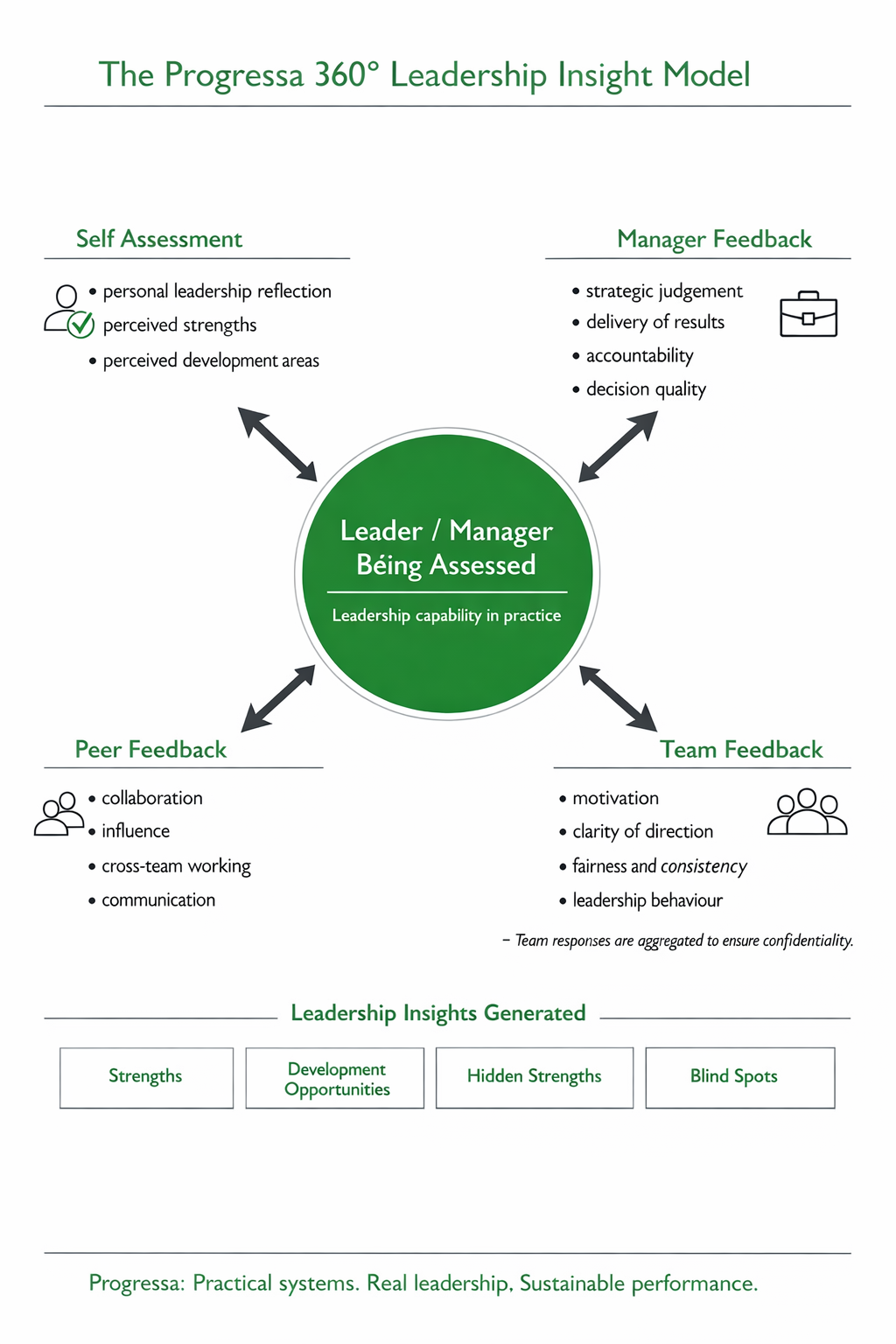
A 360-degree feedback process collects structured input on leadership behaviour from four directions. The individual assesses themselves. Their direct manager provides feedback. Their peers, the people who work alongside them at a similar level, share their perspective. And the team they manage provides anonymous, aggregated feedback on how they experience the leadership they receive.
Each of these perspectives reveals something different. Self-assessment shows how the leader perceives their own strengths and gaps. Manager feedback captures strategic judgement, accountability, and delivery of results. Peer feedback surfaces collaboration, influence, and communication across departments. Team feedback exposes the lived experience of being managed by that person: clarity of direction, fairness, motivation, and the consistency of day-to-day behaviour.
The value is in the combination. A manager might present as decisive and organised when reporting upwards, while their team experiences something closer to abrupt direction-setting with unclear expectations. Another might be genuinely respected by their team but struggle to influence peers, which limits their effectiveness across the wider business. Traditional appraisals rarely catch these patterns because they only ask one group of people.
The Perception Gap: Where Leadership Problems Actually Begin
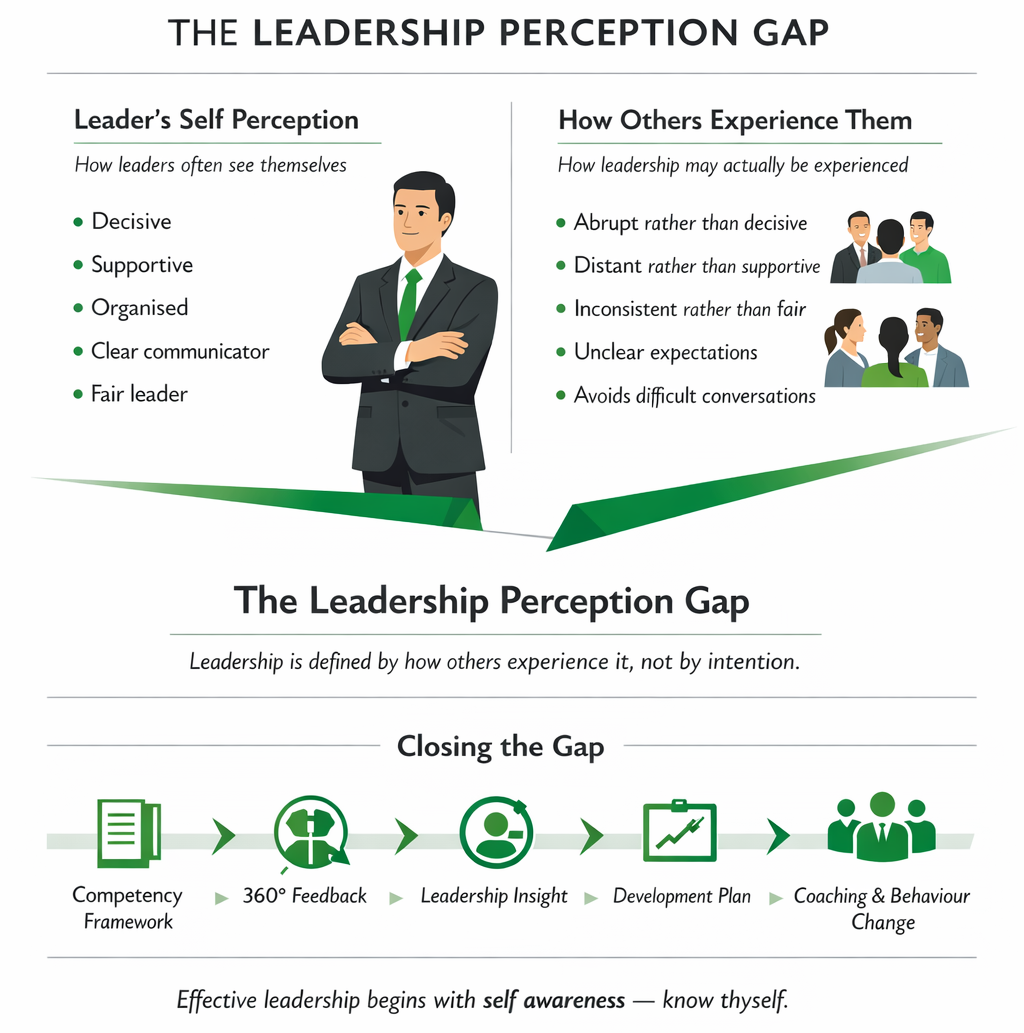
One of the most consistently valuable findings from 360-degree feedback is the perception gap: the distance between how a leader sees themselves and how others experience them.
Most leaders, understandably, believe they have a reasonable grasp of their own style. They would describe themselves as decisive, supportive, fair, and well-organised. And in many cases they are partly right. But the version of leadership experienced by the people around them can look quite different. A leader who considers themselves supportive may, in practice, be experienced as distant or difficult to reach. Someone who believes they communicate clearly may leave their team working with vague expectations. These gaps are not personality flaws. They are behavioural patterns that develop over time, often reinforced by the fact that nobody ever provides honest, structured feedback on them.
The perception gap matters because leadership is ultimately defined by how it is experienced, not by how it is intended. An MD who believes their management team is strong, based on upward reporting alone, may be missing the reality their teams live with every day.
Starting With the Right Competencies
Effective 360-degree feedback begins with defining what good leadership looks like for the specific role being assessed. This is more important than it sounds, because generic competency lists pulled from management textbooks rarely reflect the actual demands of the job.
A competency framework for a 360 assessment typically includes somewhere between 20 and 30 competencies, covering areas such as decision-making, communication, team development, accountability, collaboration, and strategic thinking. But the mix should vary by role. A senior executive needs stronger competencies in strategic judgement and the ability to make decisions under genuine uncertainty. A mid-level manager might need sharper capability in operational leadership, team motivation, and performance management. A supervisor's framework should weight communication, accountability, and day-to-day operational discipline more heavily.
Getting this right at the outset determines whether the feedback is genuinely useful or just another box-ticking exercise. The competencies should describe the real responsibilities of the role within the specific organisation, not an idealised model of leadership in the abstract.
What the Feedback Typically Reveals
When feedback from all four perspectives is analysed, a set of patterns usually emerges. Some are expected. Others can be genuinely surprising.
Leadership strengths are the competencies where feedback is consistently positive across multiple groups. These represent genuine capability the individual should continue to develop and lean into. Development opportunities are the areas where feedback indicates gaps or inconsistency. These usually become the primary focus of any development plan that follows.
Then there are two categories that make 360 feedback particularly powerful. Hidden strengths are competencies where the individual rates themselves modestly, but the people around them rate them highly. Discovering these can significantly shift a leader's confidence and their willingness to step into responsibilities they had been holding back from. And blind spots are the inverse: areas where the leader believes they are strong, but others experience something different. These are often the most commercially valuable insights in the entire process, because they identify behaviours that may have been undermining performance for years without anyone naming them directly.
Leadership Works in All Directions
One of the most illuminating aspects of 360-degree feedback is the difference between how someone is perceived by their boss, their peers, and their team. These three relationships each carry different demands, and few leaders are equally effective in all of them.
Some managers build strong relationships with senior leaders. They report well, present confidently, and are seen as reliable from the above. But the team underneath them may tell a different story. Others are respected and trusted by their teams, but struggle to influence peers across departments, which limits their ability to drive cross-functional work. As leaders become more senior, the ability to operate effectively in all three directions becomes increasingly critical.
A strong relationship with a chairman or board does not guarantee organisational effectiveness if the people beneath you lack confidence in your judgement. In fact, that imbalance can erode performance steadily over time in ways that only become visible once the damage is already significant.
Self-Awareness as a Leadership Foundation
One of the persistent barriers to leadership development is the assumption that strong leaders should not have significant weaknesses. Satya Nadella had to substantially rework his leadership approach when he took over as CEO of Microsoft, and he has spoken openly about the role self-awareness played in that transition. The most effective leaders tend to be those willing to confront their own gaps honestly, either by working to close them or by building teams that complement them.
Avoiding that kind of honest self-assessment is what allows problems to compound. A leader who cannot see their own blind spots cannot address the effect those blind spots have on their team, their peers, or the wider organisation. Structured feedback provides the mechanism to surface that awareness in a way that feels constructive rather than punitive.
From Feedback to Development That Actually Changes Behaviour
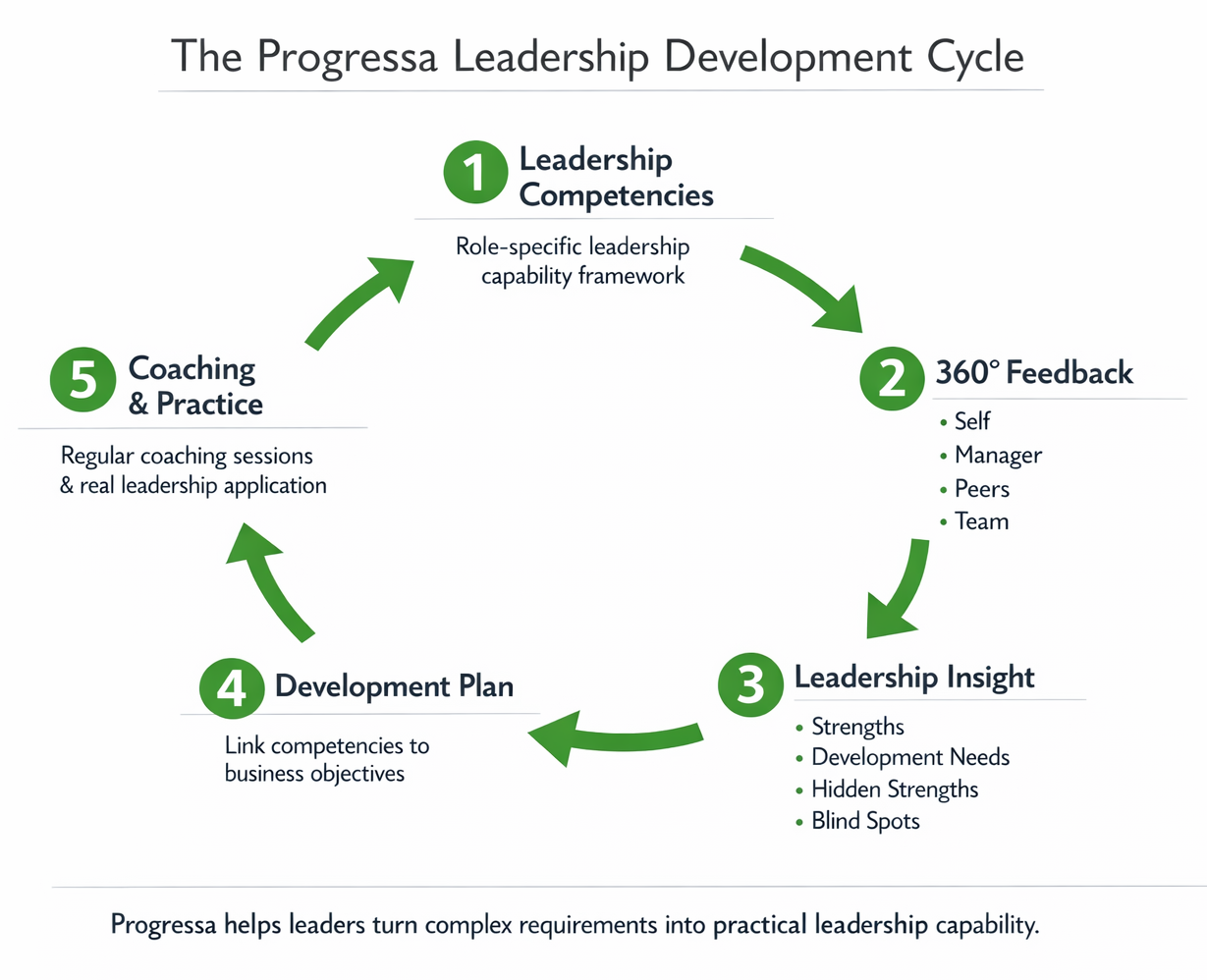
The purpose of a 360-degree assessment is not to produce a report. It is to create a development plan that connects leadership capability directly to business objectives. Once strengths, development needs, hidden strengths, and blind spots are identified, the organisation can focus its investment on the competencies that will make the greatest difference to operational performance.
This is where structured leadership coaching becomes valuable. Understanding a competency gap intellectually is one thing. Changing the behaviour that sits behind it is considerably harder. Coaching gives leaders a space to work through real challenges: managing underperformance, holding difficult conversations, making decisions under genuine pressure, and balancing operational demands with the responsibility to lead people well. Two conversations decide whether a report changes anything: the debrief that turns the findings into three priorities, and the ninety days after it, when a manager who agreed to change starts slipping back.
The combination of structured feedback and ongoing coaching is what separates development that changes behaviour from training that changes nothing. Over time, this approach strengthens management capability across the organisation in ways that show up in retention, productivity, safety performance, and the quality of decision-making at every level. If you recognise inconsistent leadership as an issue in your business, ProgressA's leadership development and coaching support may be worth a conversation.
Final Thought
Most managers believe they understand their own leadership style. Sometimes they do. But leadership is defined by how others experience it, and the distance between intention and impact is often wider than anyone expects.
A structured 360-degree feedback process reveals that distance. For leaders willing to listen, reflect, and develop, the insight it provides can reshape how they lead, how their teams perform, and how the business operates.
It comes back to a principle that has guided leaders for a very long time: know thyself.


