
The 360 conversation no one runs properly: turning feedback into a manager who actually changes
Three weeks after the 360 reports came back, the managing director noticed that nobody had mentioned them since. He ran an engineering business of around 45 people and had commissioned assessments on his four managers in the spring, partly because a client he respected had recommended the exercise and partly because one of the four had been worrying him. Each manager received their report in a short meeting in his office. One went quiet somewhere around page two, then spent the remaining twenty minutes explaining why his peer feedback was unfair. Another thanked him, took the document away, and never referred to it again. By early summer the reports had dropped out of conversation entirely, and the business was running exactly as it had before.
Nothing about this is unusual. The assessment itself was sound and the data genuinely revealing. What failed was the part of the process that carries almost all of the weight and receives almost none of the attention: the conversation in which the manager makes sense of what the data says about them. Get that conversation wrong and the whole exercise becomes an expensive way of confirming that feedback, on its own, changes nothing.
The data changes nothing on its own
That last sentence describes a research finding. A study by Seifert and colleagues split managers into groups after a multisource assessment. One group received their feedback together with a facilitated session in which they worked through the results and built a plan for acting on them. The others received the feedback report alone. The facilitated group measurably improved how they worked with their teams in the months that followed. The managers who received the report on its own did not change at all. Same assessment, same data, same organisation. The only variable was the structured conversation wrapped around the results.
The wider evidence points the same way. The largest meta-analysis on the subject, by Smither, London and Reilly in 2005, found that performance improvement after 360 feedback is real but small on average, and concentrated among the managers who set specific goals and had support in acting on them. A related study by the same researchers followed over 1,300 senior managers after a multisource assessment, and those who worked with a coach afterwards set sharper goals and improved more than those left with the report and their own good intentions.
Read together, the research describes a cost structure that surprises many businesses commissioning a 360 for the first time. The assessment is the cheap part. Almost all of the value arrives, or evaporates, in what happens after the report exists. For a fuller picture of what 360 data typically reveals about a leadership team, the patterns are covered in a companion article. This one is about the conversation that decides whether any of it matters.
Where the debrief collapses
Four failure patterns account for nearly every wasted 360, and each happens at a recognisable moment.
The commonest is the boss running the conversation. It feels efficient, and in a business of forty people there is rarely anyone else to do it. But the moment the MD opens the report across the desk, the manager stops hearing development feedback and starts hearing an appraisal. Defensiveness follows within minutes, usually at the first perception gap, the point where what the team experiences diverges from what the manager believes about themselves. Those gaps are the most valuable findings in the entire report, and they are precisely the ones a defensive manager will explain away.
The second failure needs less description because it is simply absence. The report gets emailed over, perhaps with a line inviting the manager to have a read through, and no conversation follows at all. Left to interpret complex and sometimes uncomfortable data alone, the typical recipient fixates on one negative comment and discounts everything else the report was telling them.
Third is overload. The debrief happens, but it marches the manager through every finding in the document, so twenty observations arrive with equal weight. The manager nods through all of them, retains a handful, commits to none, and leaves with a vague sense of having been assessed rather than a clear sense of what to work on.
The fourth failure is quieter and does its damage before the report is even written. When a 360 gets tangled with pay review or a live performance concern, everyone involved adjusts. Raters soften or sharpen their scores depending on what they think the consequences will be, and the recipient reads every line through the question of what it means for their position. The developmental value collapses at both ends. Keeping the assessment entirely separate from formal performance management is one of the few points on which the research and the practitioner guidance agree completely.
What a structured debrief involves
A debrief that works is defined as much by what happens outside the meeting as inside it.
Before the conversation, the facilitator has read the report closely and formed a view on what matters. Which findings are urgent, which are background, where the perception gaps are, and where the manager is likely to push back. That preparation is what allows the conversation to move at the manager's pace rather than page by page through the document.
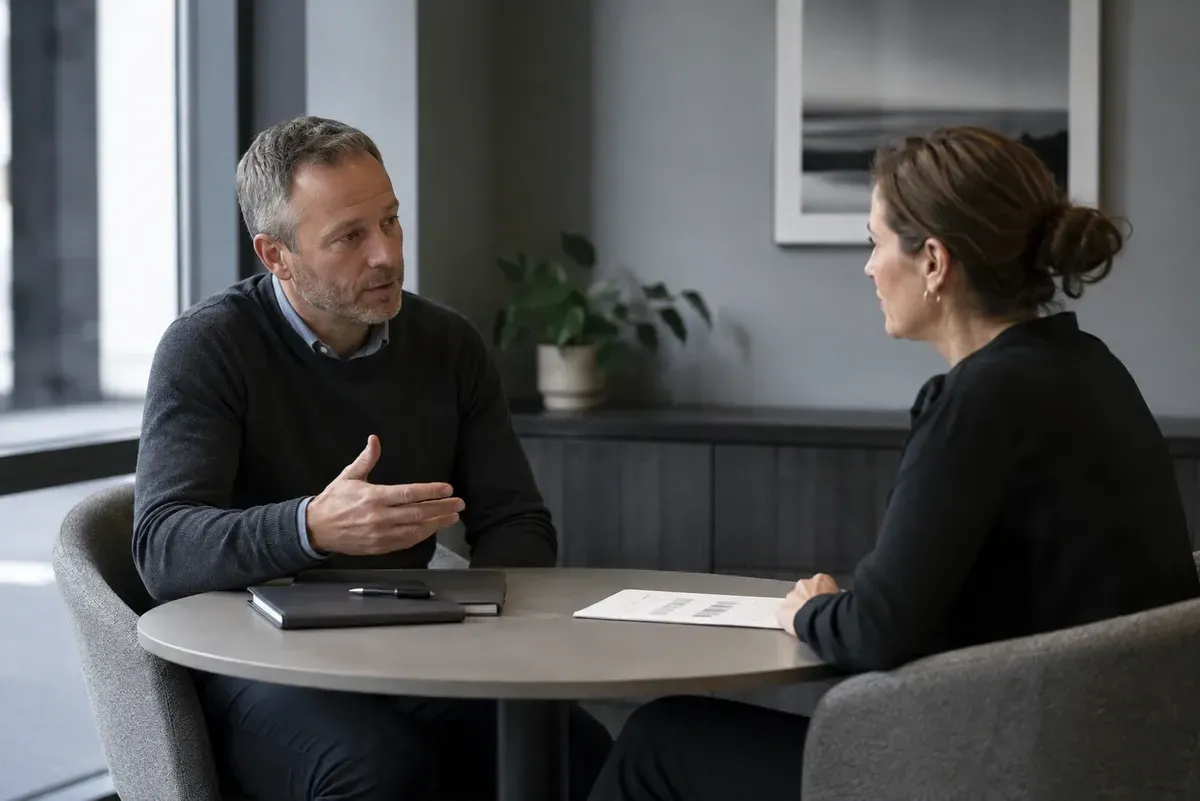
In the room, the format our business coaching uses is deliberately modest. One hour, one-to-one, no slide deck, and a facilitator who is external to the business, which removes the appraisal dynamic that sinks boss-led debriefs. The conversation opens with the manager's own reaction rather than the facilitator's summary, because how someone responds to their data reveals nearly as much as the data itself. From there the work is interpretive. The facilitator helps the manager understand what a perception gap means in the context of their actual role, rather than debating whether the raters were right. A manager who scores differently with peers than with their own team is usually behaving differently under different pressures, and recognising that pattern themselves is worth more than being told it.
The end of the hour is where the structure earns its keep. The manager leaves with their top three development priorities, chosen by them from the findings rather than assigned to them. Three is enough to be specific and few enough to survive contact with a normal working week. Each priority is then tied to real situations the manager will face in the role, because the difference between a vague priority and a usable one is the difference between "delegate more" and "hand the Thursday production meeting to your deputy and stay out of it for a month."
The ninety days that decide whether anything changed
The typical SME 360 process ends at the debrief, and this is where even the well-run ones fall short of what the assessment could have produced. Behaviour change in managers follows the same rules as behaviour change anywhere else. It needs repetition, and it needs someone to work through the moments when the old habit reasserts itself, which a single conversation rarely supplies, however skilfully it was run. This is why the research keeps finding that coaching after the assessment separates the managers who improve from the managers who merely got measured.
In practice, the written plan from the debrief becomes the agenda for a coaching relationship over the following six to twelve months, revisited as the manager's real situations test it. That is the shape of structured coaching after a 360 assessment as Grow runs it: the assessment surfaces the priorities, the debrief secures them, and the coaching turns them into changed behaviour in the job itself.
For the MD, the useful question at the ninety-day mark is observational. Two signs say it is working. The manager refers to their priorities unprompted, in normal conversation, because they have become part of how that person thinks about their own performance rather than a document from a process. And someone on their team notices a specific difference without being asked to look for one. If neither has happened by month three, the assessment measured the manager and then left them exactly where it found them, and it is worth asking whether the conversation that was supposed to follow ever really took place. What the managing director does in those ninety days, including when the answer turns out to be no, is set out in the ninety days after a debrief, when the first bad month arrives.
If your business has run 360 feedback, or is about to, and you could not point to a single manager behaviour that changed as a result, a short message to us gets you a direct view on why, and on how a structured debrief and follow-through would run for your specific team.


